Search Engines Other Than Google: Which Ones Are Worth It
Search engines other than Google are worth trying for privacy, AI-style answers, local results and archived pages, not as a full replacement.
Why look at search engines other than Google at all
In short: Google runs most of the world's searches, but search engines other than Google can still beat it for privacy, AI-written answers, local results in places like China or Russia, and finding a page Google has deleted.
If you write content for your own site, it helps to know these engines aren't all separate indexes built from scratch. DuckDuckGo's own help page says its links are largely sourced from Bing, and Yahoo's organic results have run on Microsoft's platform since 2010, so SEO work aimed at Google usually reaches them too. Worth knowing before you write a word of it. If you'd rather have that writing done for you, the plan breakdown for blogwriter.pro's Mac app is on the pricing page.
Type something into Google and you get ten blue links, a few ads sitting above them, and a search history that quietly follows you into every other Google product you use. None of that is new. What's changed is that it's no longer the only competent option sitting on the table, and for a growing number of specific jobs, it isn't even the best one.
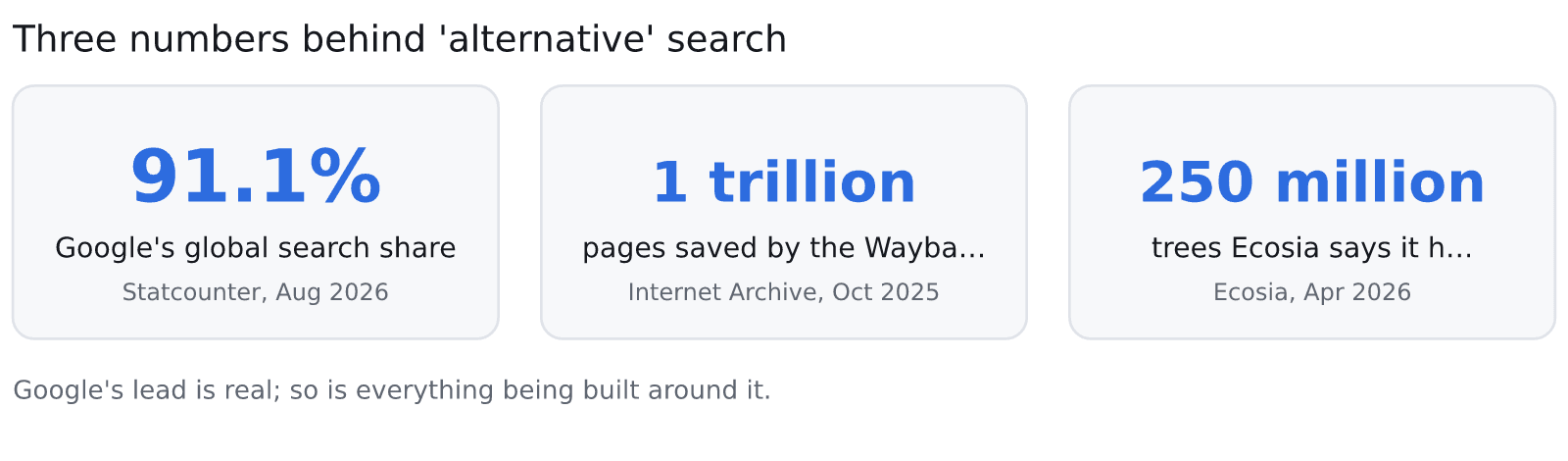
Every alternative below does one thing better than Google, and most of them do it by giving something up in return. DuckDuckGo won't build a profile tied to your searches, but it still leans on Bing for the ordinary links underneath. Ecosia funds tree planting with its ad revenue, and says it has planted 250 million trees since it was founded in 2009, but its results still come from Bing, Google and a search partner called EUSP depending on the query, the same handful of providers everyone else is drawing from. None of them are trying to be a full Google replacement. Treating one like it is the reason most "alternative search engine" roundups feel like a waste of ten minutes: they list seventeen names and never say what any of them are actually for.
There's also a quieter reason to keep more than one search engine in rotation, and it has nothing to do with privacy or novelty. One company deciding what counts as a good answer, for the whole planet, at once, is a strange amount of quiet power to hand to a single index. You don't have to distrust Google to think that's worth hedging against a little, the same way you'd rather not have one bank, one map, or one weather source. Diversity of search is closer to diversity of information than it looks from the address bar.
Google's lead is real, but it isn't the same everywhere
Google took 91.1% of global search referrals in August 2026, according to Statcounter, which pulls the figure from traffic across more than a million sites. Bing came a distant second at 4.5%, Yahoo at 1.23%, Yandex at 0.99%, DuckDuckGo at 0.7%, and Baidu at 0.62%. On a chart of the whole world, everything that isn't Google rounds down to a sliver you'd need to squint at.
Zoom into a single country and that picture flips hard. In China, Baidu held 59.26% of search share against Google's 1.41% in August 2026, also per Statcounter. In South Korea, Google's lead over Naver was razor thin, 46.6% to 43.71%, close enough that calling one the "alternative" is arguable. In Russia, Yandex held 70.35% against Google's 27.79%. Three countries. Three different reasons Google isn't the default. None of them is a rounding error, not if you're searching, or being searched for, from any of the three.
Anyone who checks how their own site is doing in "search" and only ever means Google is measuring the wrong thing for a meaningful slice of the world. It's an easy mistake, because most SEO tools default to Google's numbers and stop there. The three engines below don't show up in that default view at all, and neither does the traffic they're sending, or not sending, to sites written with only one search engine in mind.
When you don't want to be tracked: DuckDuckGo, Brave Search, Startpage
Google makes its money by knowing what you searched, what you clicked next, and what you did after that. That's the deal you're making every time you use it for free. For a lot of searches, a symptom you're worried about, a legal question, something about a person you just met, it's a deal you'd rather not make. Even if nothing bad ever comes of it.
DuckDuckGo's whole pitch rests on refusing that deal. Its help pages say plainly that "DuckDuckGo never tracks you, per our privacy policy," treating every search as a fresh session with nothing saved and no profile being built behind it. What it doesn't do is run its own index of ordinary web pages: by its own account, it "largely source[s]" traditional links and images "from Bing," and fills in the rest, instant answers, definitions, sports scores, from a range of other named sources like Wikipedia. Bing does the finding. You stay unknown.
Brave Search used to work the same way, leaning on Bing's API for part of its results. It doesn't anymore. Brave says "every Web search result seen in Brave Search is now served by our own index," having removed the last of its calls to Bing entirely. That's a genuinely independent search engine now, crawled and ranked by Brave itself. Its image and video search still sometimes hand off to Bing or Google when Brave's own coverage runs thin, but the ordinary web results don't.
Startpage takes a third route, and doesn't try to build an index of its own at all. In its own words, quoted on its Wikipedia page since Startpage doesn't publish these as a chart the way Statcounter does, "we're paying them to use their brilliant search results in order to remove all trackers and logs," referring to Google. It says it stopped recording user IP addresses in January 2009. Same results. A different watcher, or none at all.
None of the three is private everywhere on the internet, only in the moment of searching. Click through to a site from any of them and that site's own trackers start doing what they always do.
Trying one costs nothing. Every major browser lets you add a new search engine and set it as the default from the same settings screen where you'd change your homepage, no extension or account required. Keep Google in the list too. Switching the default doesn't delete it, it just decides which one answers first when you type into the address bar instead of opening a new tab on purpose.

When you want an answer instead of ten links: Perplexity, Bing's Copilot Search
Sometimes you don't want a list of pages to read. You want the answer, in a sentence, with something to check it against. That's the gap Perplexity and Microsoft's Copilot Search, built into Bing, are both trying to close.
Microsoft's own reasoning for putting a chat layer into Bing, laid out when it launched the AI-powered version in February 2023, was blunt about it: "There are 10 billion search queries a day, but we estimate half of them go unanswered. That's because people are using search to do things it wasn't originally designed to do." Ask Bing's Copilot Search a real question now and it reads across several pages, then hands back a written answer with links to where each part came from, instead of leaving you to open five tabs and do that yourself.
Perplexity gets to the same place from a different starting point. It wasn't built as a search engine with a chat feature bolted on afterward; it was built as an answer engine from the start. Type a question and it comes back with a short written answer and citations you can click through and check, rather than a page of results for you to sort through and decide which one actually answers what you asked.
Neither one replaces a search engine for the thing search engines still do better: finding a specific page you half-remember, comparing prices across ten stores at once, or scrolling past the first result on purpose because you don't trust it. What they're good for is the question that would otherwise cost you four tabs and twenty minutes: a comparison, a definition with context, a "why does this happen" that used to mean reading three articles to piece together yourself. And because both hand you a written answer rather than a source list, it's worth actually clicking the citation before you repeat what it told you. An AI answer is only as good as the page it read.
That last part matters more than the pitch for either tool ever mentions. A written answer feels more finished than a list of links, and that feeling is exactly why it's worth resisting a little. A page of results makes you do the comparing, which is slower but also the moment you'd notice if two sources disagreed. A single written answer can quietly pick a side for you. Neither Perplexity nor Bing invents its answer out of nowhere, both cite where the sentence came from, but citing a source and reading it are two different habits, and only one of them catches a mistake.

When you're not searching from an English-speaking country: Yandex, Baidu, Naver
Google's global share hides how uneven it is by country, and this is where "search engine other than Google" stops being a niche choice and starts being the ordinary default for hundreds of millions of people.
Where the leading local search engine actually leads, by country, August 2026
| Country | Leading engine (not Google) | Its share | Google's share |
|---|---|---|---|
| China | Baidu | 59.26% | 1.41% |
| Russia | Yandex | 70.35% | 27.79% |
| South Korea | Naver | 43.71% | 46.6% |
Source: Statcounter
Baidu built its lead the ordinary way: it launched earlier for Chinese-language search and kept adapting to it, while Google's own service has operated under restrictions in China for years, which shows up plainly in that 1.41% figure above. Yandex is Russia's Google in almost every practical sense, running its own search, maps, mail and ad network end to end. A head start plus a home crowd. That's what a 70.35% share looks like. Naver in South Korea is the closest race on the table: the two engines are close enough to a coin flip that assuming "everyone searches on Google" is already wrong for something close to half the country, and Naver's own network of blogs and forums shapes what actually ranks there in ways Google's index doesn't reach.
If your work, or your reading, touches any of these three countries, checking your visibility on Google alone and stopping there is a mistake with an exact number attached to it.
When the page you need has already been deleted: the Wayback Machine
None of the search engines above help with the single most common reason to leave Google behind: the page is gone, and Google's index only ever shows you what's live right now, never what used to be there.
The Internet Archive's Wayback Machine exists for exactly that gap. It isn't a search engine in the usual sense; you don't type a question and get a ranked list back. You paste in a URL and it shows you what that page looked like on whatever date it happened to be crawled. In October 2025 the Internet Archive marked what it called "an extraordinary milestone: 1 trillion web pages preserved and available for access via the Wayback Machine," a total that's been building since the project started saving pages back in 1996.
That's the tool for the broken link in an old article, the deleted post somebody's quoting at you, the version of a company's pricing page from before they quietly changed it. Google can't help with any of that. It only knows about the page that exists today, not the one that existed last year.
Journalists lean on it to prove a company said something before it edited the page. Researchers cite it because a footnote pointing at a URL is worthless once that URL redirects somewhere else. Ordinary people use it for smaller stakes: the recipe that vanished when a food blog redesigned, the forum post with the actual fix buried in a thread that's since been taken down. None of that is a search in the way Google means the word. It's retrieval, on purpose, of something that was already found once.

When you want a calculation, not a search: WolframAlpha
WolframAlpha isn't trying to compete with Google at all, and it says so itself. Its own about page describes "a fundamentally new paradigm for getting knowledge and answers, not by searching the web, but by doing dynamic computations based on a vast collection of built-in data, algorithms and methods."
In practice: you ask it a math problem, a unit conversion, a date calculation, or anything with a definite numeric answer, and it computes that answer rather than pointing you toward a page that might contain it. Ask Google "derivative of x squared" and you get a list of pages about derivatives, some of which have the answer and some of which don't. Ask WolframAlpha the same question and it works the problem itself and shows you the steps it took to get there.
It's a narrow tool on purpose. It won't help you find a restaurant, a news story, or an opinion on anything. But for the specific job of "I need this number and I need it to be right the first time," it does something none of the search engines above are actually built to do.
A currency conversion, a nutrition breakdown, how many days between two dates, what a given interest rate compounds to over time: these are all questions Google will happily answer too, usually with its own calculator box sitting above the results. The difference shows up once the question gets slightly less standard. Ask something with two or three moving parts at once and Google tends to fall back on a list of pages that might explain it, while WolframAlpha keeps computing, because computing rather than searching was the whole design from the start.
How to actually choose
Most people don't need to pick one search engine and abandon the rest. The people who get the most out of this list treat it like a small toolbox: Google, or Bing if you're already living inside Microsoft's tools through Edge, stays the everyday default, and one or two others get added for the specific job they're good at. Pick based on the search you do most often that Google handles worst, not on which name sounds most interesting.
Which search engine other than Google to reach for, and why
| Engine | Reach for it when | One thing worth knowing |
|---|---|---|
| DuckDuckGo | You don't want a search history at all | Its links mostly come from Bing, sourced without Bing knowing it's you |
| Brave Search | You want privacy from an engine that isn't leaning on anyone else's index | Fully independent since it removed its last calls to Bing's API |
| Startpage | You want Google's exact result quality, minus the tracking | Pays Google for results, then strips the trackers and logs |
| Perplexity | You want one written answer with citations, not ten links to sort through | Built as an answer engine, not a search engine with chat added on |
| Bing (Copilot Search) | You want the same thing, inside the search engine you already have open | Grew out of Microsoft's 2023 bet that half of searches go unanswered |
| Baidu, Yandex or Naver | You're searching from China, Russia or South Korea | Each is the genuine local default there, not a niche pick |
| Wayback Machine | The page you need no longer exists | Shows a URL as it looked on a past date, not what's live now |
| WolframAlpha | You need a computed answer, not a linked page | Computes from built-in data instead of searching the web |
None of that requires giving up Google for good. It means changing which tab you open for which question, the same way you already keep a separate app for maps and a separate one for email instead of asking one tool to do everything badly.

Frequently asked questions
Is any search engine actually more private than Google?
Yes, for the specific act of searching. DuckDuckGo, Brave Search and Startpage all say they don't build a profile tied to your searches, unlike Google's model, which depends on knowing what you searched. DuckDuckGo's help pages put it plainly: "DuckDuckGo never tracks you, per our privacy policy." None of the three is private everywhere on the internet, only in the moment of searching; clicking through to a site still exposes you to whatever that site does with visitors.
Do these search engines use their own results, or someone else's?
It depends on the engine, and it's worth knowing before you assume you're getting something totally different. Brave Search now runs on its own index, after removing the last of its calls to Bing's API. DuckDuckGo and Yahoo both still largely use Bing's results for ordinary links. Startpage pays to use Google's own results and strips the tracking around them. Ecosia mixes results from Bing, Google and a partner called EUSP depending on the query. Very few names on a typical "alternatives to Google" list are running a fully separate index built from scratch.
Will switching search engines mean I can't find things as easily?
Not for most everyday searches, since several of these engines are drawing from the same underlying index as each other anyway. Where you'll actually feel a difference is at the edges: an answer engine like Perplexity is faster for a question that would otherwise take you across several tabs, and Google, or Bing, or Baidu, depending on your country, still has the deepest index for an obscure or very recent page.
Are AI answer engines like Perplexity going to replace search engines?
Not for everything they do. They're strong on questions with a clear answer that used to take several searches to piece together by hand. They're not built to replace the everyday job of finding a specific website, comparing options side by side, or just browsing instead of asking a direct question. Most people end up using both: an answer engine for questions, a search engine for browsing.
What's the single best search engine other than Google?
There isn't one, because they're not solving the same problem. DuckDuckGo and Brave Search are the pick for privacy, Perplexity or Bing's Copilot Search for a written answer instead of a list, Baidu or Yandex or Naver if you're in China, Russia or South Korea, the Wayback Machine for a page that no longer exists, and WolframAlpha for a calculation you need to be exactly right. Asking which one is "best" is like asking which tool in a toolbox is best: it depends entirely on what broke.