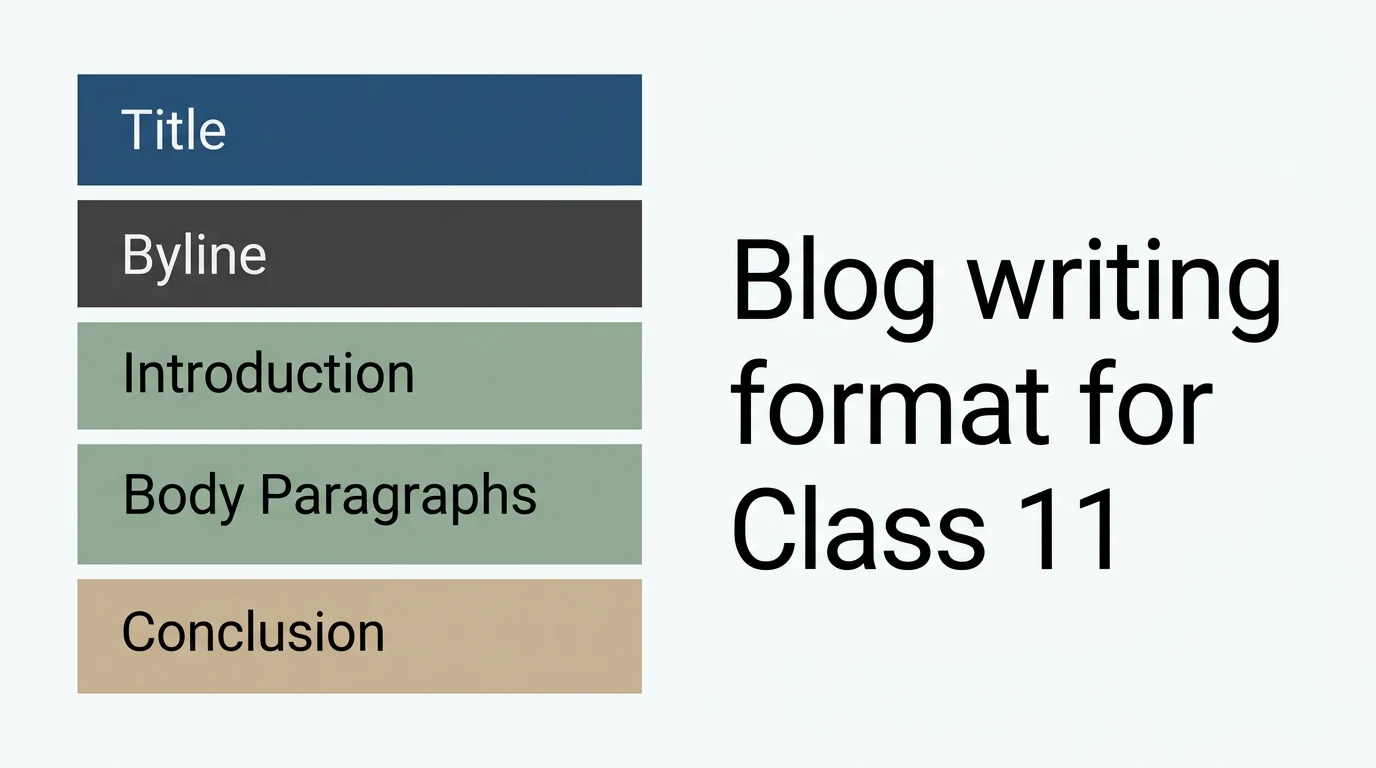
The blog writing format class 11 students are asked for is a title, a byline with the date, an introduction, a body under subheadings and a conclusion. Some boards add a blog name and a welcome-back line at the top, and a question to readers at the end. Below is each part, then a model answer.
In short: Title, byline, introduction, body, conclusion. If your paper is ISC, add a blog name at the top, a continuity note and a reader question at the end. Check your own board's sample paper before you rely on any of this.
A word on what I could and couldn't confirm. I found no official CBSE Class 11 marking scheme for a blog question. The syllabus listings I opened name note-making, summarising, essay writing, letter writing and creative writing, with no blog format. So this post gives the common student format first, then the ISC version, which does have a published checklist. Your teacher's model answer outranks both.
The blog writing format for Class 11, part by part
One student guide I read, from Vedantu, sets the format out as five parts (Vedantu, how to write a blog). Here they are, with what each should do in an exam answer.
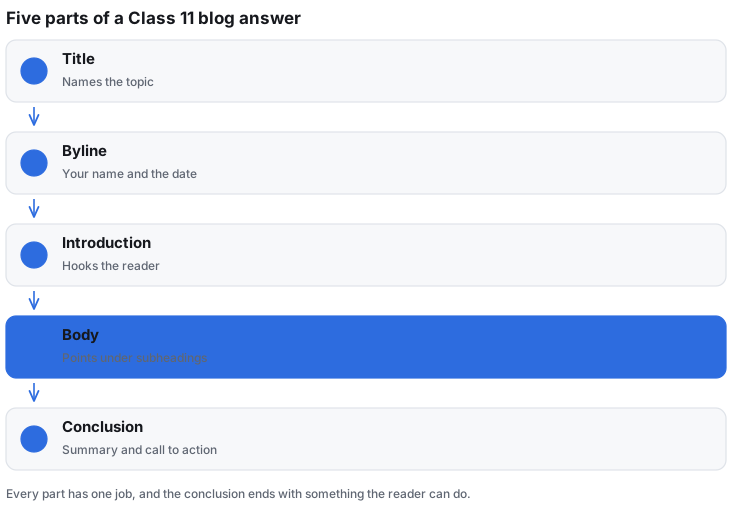
| Part | What goes in it |
|---|---|
| Title | A catchy heading that names the topic |
| Byline | Your name and the date |
| Introduction | A short overview that hooks the reader |
| Body | The main points, under subheadings |
| Conclusion | A summary, ending with a call to action |
Title. Name the topic in words a reader would click. "Why I Gave Up My Phone for a Week" beats "Mobile Phones".
Byline. One line: "By [Your Name], 3 November 2026". Use the date format your teacher uses.
Introduction. Two or three sentences. Say what the post is about and why the reader should care. Vedantu suggests opening with a question, a surprising fact or a short story.
Body. Give each point its own short paragraph, and a subheading if the answer is long enough. Use a real example for each point; the content writing samples post shows what a blog intro looks like next to other types. A blog is conversational, so write as if you're talking to one reader, and Cambridge's guidance for its own blog tasks says the same thing: informal, personal and aimed at people who share your interest in the topic (Cambridge International).
Conclusion. Sum up in a line or two. Then give the reader something to do, like trying it or leaving a comment.
The extra lines ISC asks for
ISC is where I found a written checklist. An ISC directed-writing guide on Englicist lists five format elements: blog name, post title, byline and dateline, continuity note and reader interaction (Englicist).
- Blog name at the very top. It names the site, not the post.
- Post title below it.
- Byline and dateline in one line: "Posted by [Name] on [Day, Date Month Year]".
- Continuity note, usually the opening line: "Welcome back, readers."
- Reader interaction, a closing question or invitation to comment.
The same guide gives the mark split as 1 for format, 2 for expression and 12 for content, 15 in all. It says blog writing enters ISC from 2027. It sets no official word limit, but its plan aims for about 300 words. Its paragraph guide is roughly 50 to 60 words for the introduction, 60 to 70 for each of two body points and 50 to 60 for the conclusion, which adds up to less than 300, so treat it as a rough guide. These are one coaching site's figures, not the board's. Check the board's specimen paper.
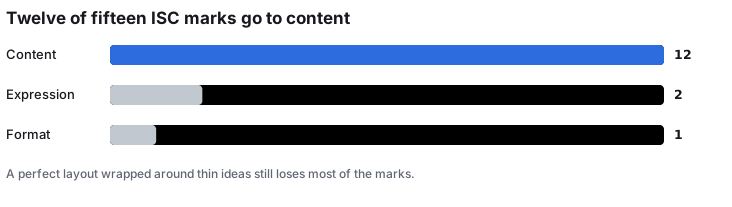
Look at how little of the mark is for format. Twelve of fifteen go to content, so a perfect layout wrapped around thin ideas still loses most of the marks.
What if your chapter is a blog lesson, not a task?
Maharashtra Board's Class 11 English has a chapter on blog writing (3.2). The version I read online is a reading lesson: it defines a blog, lists vocabulary and summarises what makes a good post, then sets comprehension questions of 2 marks each (BhashaLab). It gives no formal template to copy. If that's your board, follow your textbook and teacher for the layout, and use the five parts above as a safe default.
A short model answer
This one uses the ISC extras. For a plain Class 11 answer, drop the blog name, the welcome line and the closing question, unless your teacher likes them.
The Weekend Reader Why I Gave Up My Phone for a Week Posted by Asha Rao on Monday, 3 November 2026 Welcome back, readers. Last week I tried something I thought I'd never manage: seven days without my phone. The first two days were the hardest. I kept reaching for a pocket that was empty. By day three I had finished a book I had abandoned in August. I noticed the small things. I spoke to my neighbour. I walked to school instead of waiting for a lift. So would I do it again? Yes, but for a weekend, not a week. What would you give up for seven days? Tell me in the comments.
It's short on purpose. Every part is there, each paragraph does one job, and the voice is one person talking.
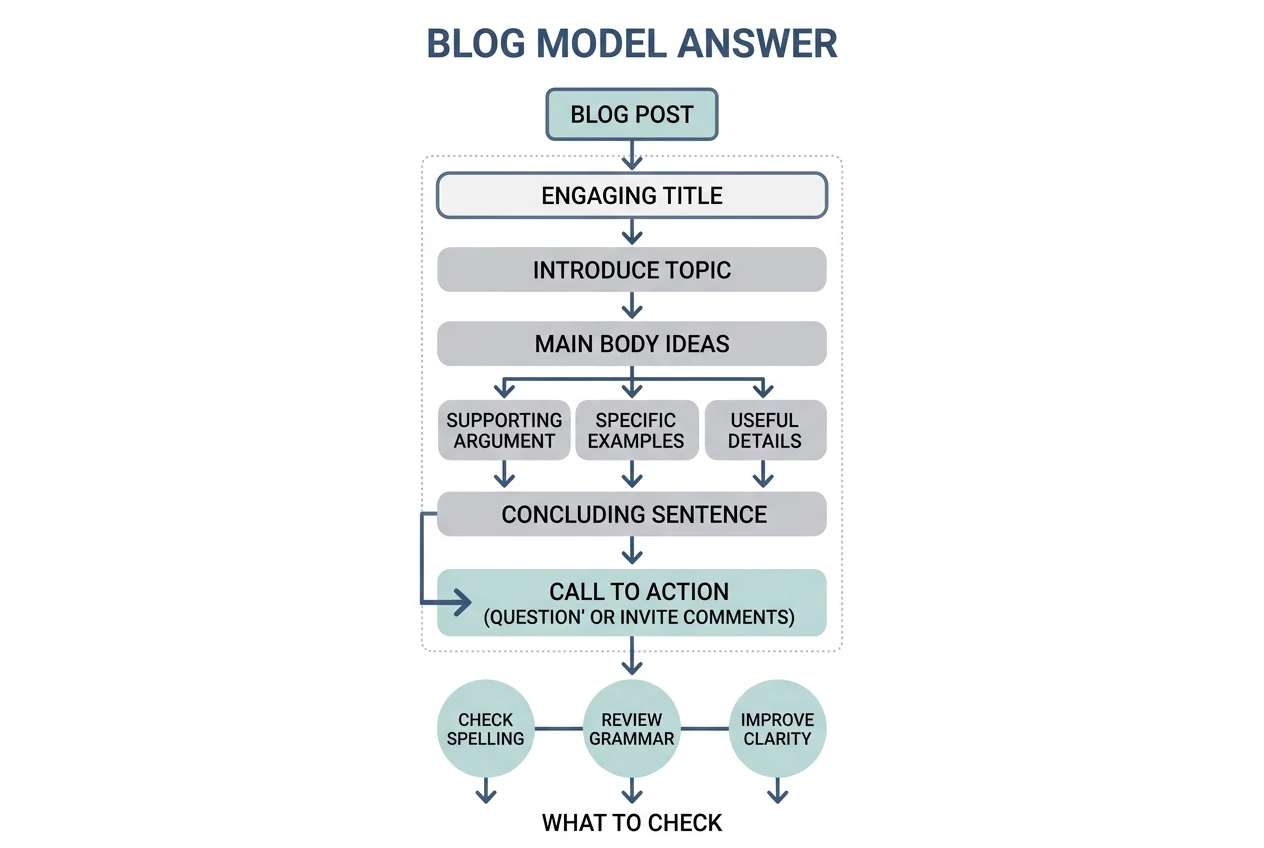
A check before you hand it in
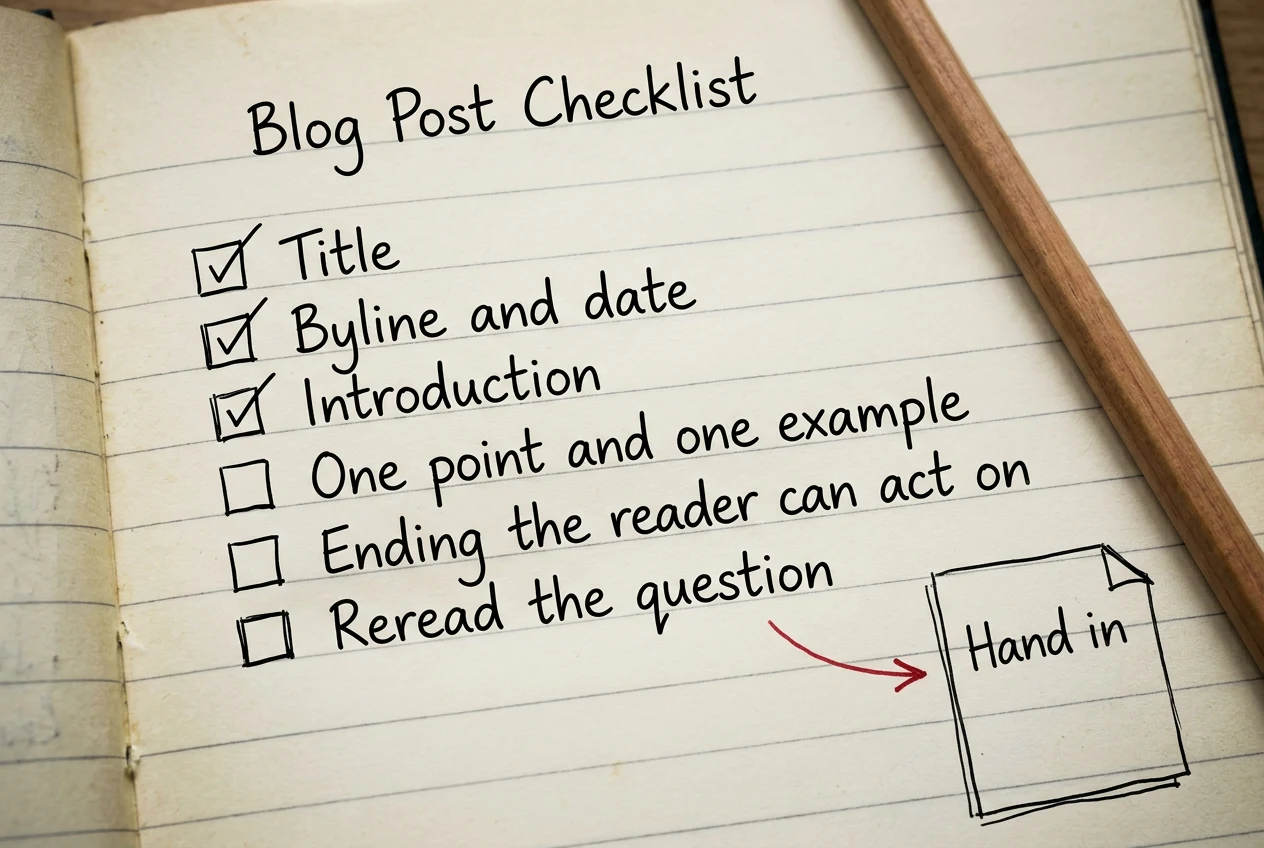
- Is the title about the topic, or only a label?
- Do the byline and date match the format your teacher uses?
- Does the introduction say what the post is about?
- Does each body paragraph have one point and one example?
- Does the conclusion end with something the reader can do?
- Did you reread the question for details it asks for, such as the blog name or topic?
If you want the same frame for a business blog rather than an exam, see the full blog writing format guide.