Good content writing samples show you what the piece is for and who it's written to. They also show how it sounds. Below are eight samples, from a blog intro to a case study, the style each one needs, and a fill-in template for each.
In short: Every type of content has a job and a voice. Pick the job first and write the answer first. Keep it short enough to scan. Eight samples and fill-in templates below.
I write for blogwriter.pro, which makes the blog-writing app I mention near the end. Weigh that. The samples and the method work without it.
What content writing samples should show you
A sample is only useful if you can see why it works. So every one below comes with its job and its reader first, then its style.
The samples are mine. They're written for a made-up meal planner, so none of them describes a real product, and any number in them is a placeholder. Swap in your own facts, and source every figure you keep.
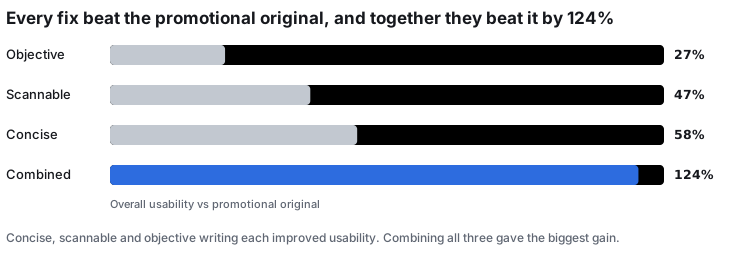
It helps to know how people read. Nielsen Norman Group tested five versions of one travel website: a promotional one, a shorter one, a scannable one, a factual one and a version with all three fixes. Compared with the promotional original, the concise version scored 58% better on overall usability, the scannable one 47% and the objective one 27%. The combined version scored 124% better. Their summary is blunt: users don't read on the web, they scan.
So most of what follows is one idea, repeated for eight formats. Short and scannable wins, and so does factual. I'd rather you saw that eight times than took it on trust once.
The eight types at a glance
The Write Direction lists twelve content writing formats. I've kept the eight that most people are actually asked to write.
| Type | Its job | Style |
|---|---|---|
| Blog post | Answer a question and build trust | Informative and evidence-based |
| Landing page | Get one action | Benefit-led, direct |
| Product description | Clear the last doubt before a purchase | Benefit-led, specific, scannable |
| Reach someone who already said yes | Direct, personal, one ask | |
| Social post | Earn a stop in a fast feed | Conversational and platform-aware |
| Case study | Show a result with real numbers | Narrative, specific |
| White paper | Explain something in depth and earn authority | Technical and data-driven |
| How-to | Help someone finish a task | Precise, plain, in order |
Content writing samples: eight types, side by side
1. Blog post
The job is to answer one question for someone who searched for it. Readers are often new to you, so give the answer first and the reasons second.
Busy parents often ask how to plan the week's dinners in ten minutes. Here's the short answer: write down three meals you already cook, then pick the one that fits tonight. The rest of this post shows how to turn that into a week.
Why it works: the answer is in the first two sentences, and the second one is something the reader can do straight away. Everything after it is detail. If you want the full method for this format, what to put in a blog worth reading goes further.
2. Landing page
One action is the whole job. Everything on the page either points at it or gets cut.
Plan the week's dinners in ten minutes. Weekly Plate is made for busy parents. Pick your meals, get your list. [ Try it free ]
Why it works: the headline states the benefit, not the feature. There's one line about who it's for, and one button with a verb on it.
3. Product description
The job is to clear the last doubt. Your reader is close to buying, so be specific and easy to scan.
Weekly Plate A meal planner for busy parents who want dinner decided by Monday. - Pick meals from your own list - One shopping list for the week - Works on a phone
Why it works: the first line says what the buyer gets. The list holds the specifics so nobody has to hunt for them. Only claim what the product really does.
4. Email
The job is one ask, made to someone who already knows you. Whether it gets opened depends on the subject line.
Subject: Plan the week's dinners in ten minutes Hi, Weekly Plate is for busy parents. It helps you plan the week's dinners in ten minutes. Try it free: [link]
Why it works: the subject is the benefit and the body is two sentences. The link comes right after the main point.
5. Social post
The job is to win a stop. A LinkedIn post reads nothing like a TikTok caption, and in every feed the first line does most of the work.
Dinner at 6 and nothing planned? Pick three meals you already cook. That's your week. Weekly Plate makes the list. Try it free.
Why it works: it opens on a moment the reader recognises, gives a usable tip, and ends with one step. Rewrite it for each platform instead of pasting the same text everywhere.
6. Case study
The job is proof. A case study names the problem and what was done, then what came out, and it only works if the result is real. I've left the numbers blank on purpose.
Challenge: A family of four wanted to stop deciding dinner at 5pm. What they did: They planned meals on Sunday using Weekly Plate. Result: [Add a real result you can source, and get the customer's OK before you publish it.]
Why it works: three short blocks in a fixed order. A case study with an invented number is worse than none, because the reader can't check it.
7. White paper
The job is depth. This reader has time and wants the method and the evidence, plus the limits.
Summary: Many busy parents want a faster way to plan dinners. This paper looks at how a weekly planner can help, and where it falls short. What we found: [Add a sourced finding.] Who should read it: anyone deciding whether a planner is worth trying.
Why it works: a busy reader can stop after the summary and still know what the paper says, and the "where it falls short" line is what makes a long piece credible.
8. How-to
The job is to help someone finish. Number the steps and start each one with a verb.
How to plan a week of dinners 1. Write down three meals you already cook. 2. Pick the one that fits tonight. 3. Repeat for two more nights. 4. Make one shopping list.
Why it works: one action per step, in the order the reader will do them. Add what the reader should see when a step has worked, so they know they haven't gone wrong.
Fill in the content writing samples yourself
Reading samples only gets you so far. Pick the row that matches what you're writing, copy its template and replace every [bracket] with something true. Don't keep a bracket you can't fill. Cut that line instead.
| Type | Template to copy |
|---|---|
| Blog post | [Reader] often ask how to [goal]. The short answer: [one-sentence answer]. The rest of this post shows [what it covers]. |
| Landing page | Headline: [Benefit]. Line: [Offer] is made for [reader]. Button: [Verb + outcome]. |
| Product description | [Offer]: [what the buyer gets in one line]. Then three bullets: [specific], [specific], [specific]. |
| Subject: [Benefit]. Body: [Offer] is for [reader]. It helps you [goal]. [Verb]: [link]. | |
| Social post | [A moment the reader recognises]? [One usable tip]. [Offer] [what it does]. [One next step]. |
| Case study | Challenge: [who] wanted to [goal]. What they did: [action]. Result: [a real result you can source]. |
| White paper | Summary: [the problem]. This paper looks at [the question] and where it falls short. What we found: [a sourced finding]. Who should read it: [reader]. |
| How-to | How to [goal]. 1. [Verb + action]. 2. [Verb + action]. 3. [Verb + action]. You'll know it worked when [what the reader sees]. |
Then run the check for that type before you publish: the answer comes first, each paragraph holds one idea, and every figure has a source you can name.
Writing styles: four dials
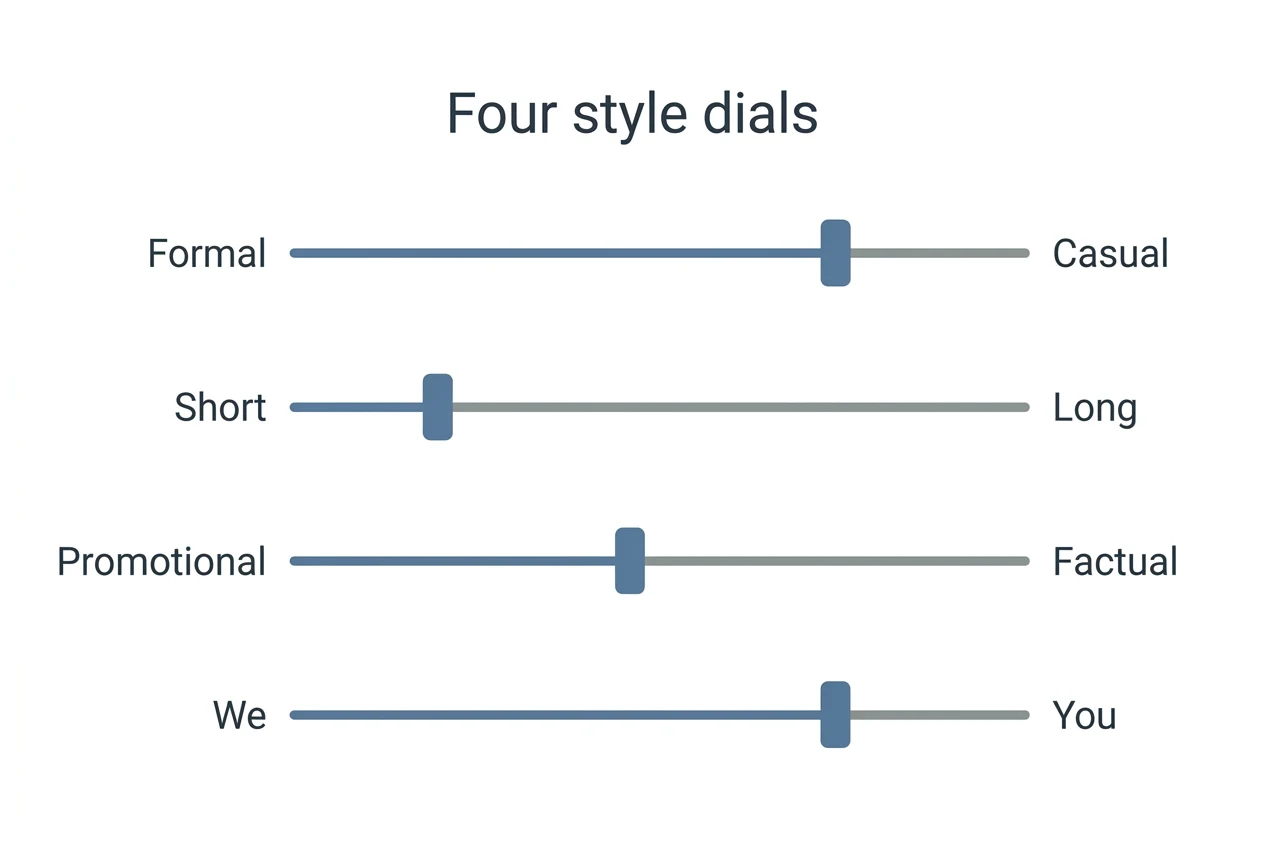
"Style" is easier to handle as four dials than as a mood.
- Formal or casual. A contract and a text message sit at the ends. Most web writing sits nearer the casual end, and a white paper sits nearer the formal one.
- Short or long. Landing pages and social posts are short. Case studies and white papers need room.
- Promotional or factual. Nielsen Norman Group's test found the factual version beat the promotional one by 27% on overall usability, and the best version combined all three fixes.
- "You" or "we". Talking to the reader ("you") usually reads warmer than talking about yourself ("we").
Pick the dials from the reader, not from taste. A parent reading on a phone at 6pm wants short and casual, with facts. A buyer evaluating software for a team may want something longer and more formal, because they have to defend the choice to someone else.
The best approach to write any piece
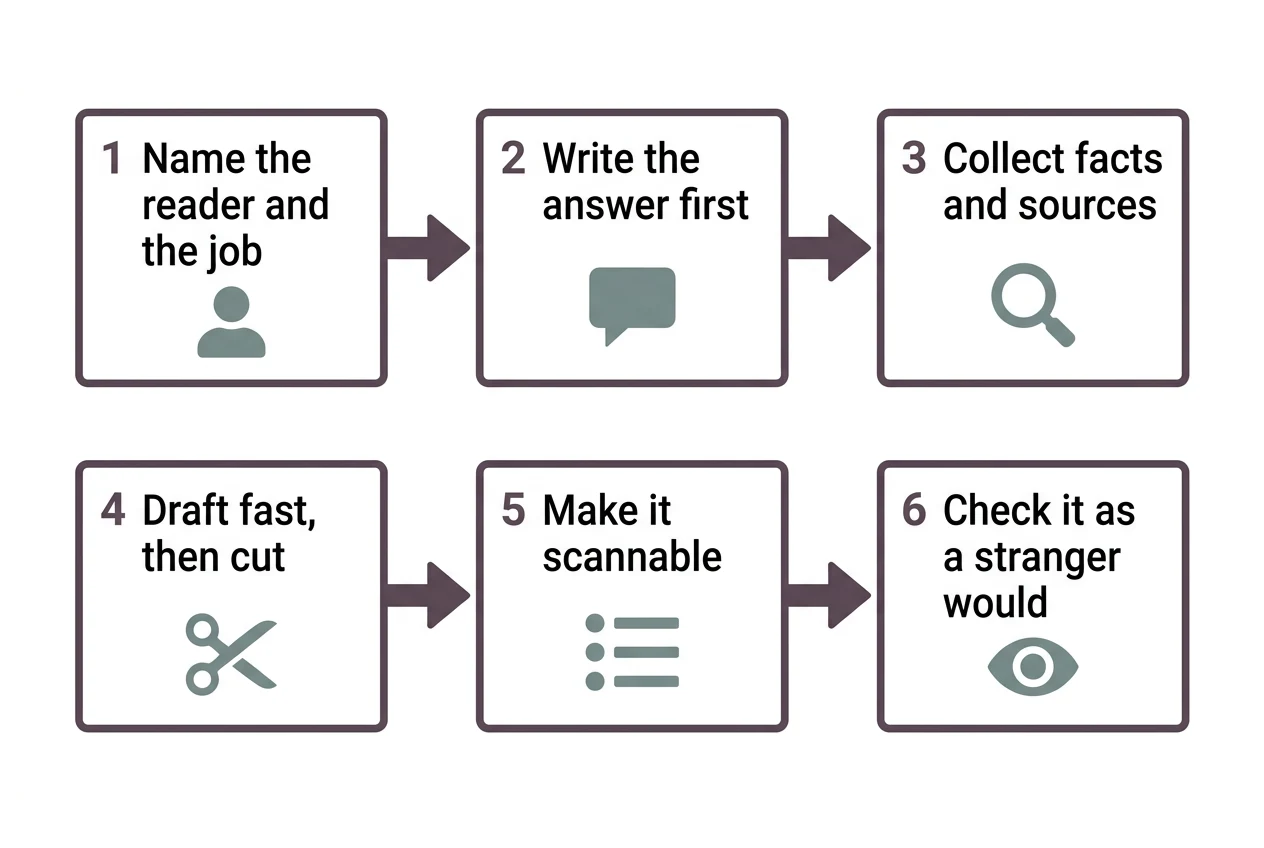
The same six steps work for all eight types. They're what I'd do for a post or a product page.
- Name the reader and the job. Finish the sentence: "Someone lands here because they want to know ___, and afterwards they can ___." If you can't, you're not ready to write.
- Write the answer first. One or two sentences, before any background.
- Collect your facts and their sources. Write the source next to each figure as you go. It's far harder to find them afterwards.
- Draft fast, then cut. Remove anything that doesn't help the reader do the job.
- Make it scannable. Use descriptive headings and short paragraphs, lists for parallel items, and a table where you compare.
- Check it as a stranger would. Read it aloud. Open each source. Ask whether you'd bookmark it or send it to a friend.
That last question isn't mine. Google's guidance on helpful, people-first content lists it as a quality question: "Is this the sort of page you'd want to bookmark, share with a friend, or recommend?" The same page asks about who wrote the piece, how it was made and why. It asks whether it's self-evident who authored your content, and whether the use of automation, including AI, is disclosed where readers would expect it. Put a byline on your work and say how it was made.
If your writing is for search, the post on what to check before you pay for SEO blog writing covers what a service should show you.
Where blogwriter fits
Most of the work above is the same for every piece: learn the business, keep to the facts it can claim, research, write, link, check, file. That is the job blogwriter does for blog posts. I'm on the seller's side here, so check it for yourself.
blogwriter is a Mac app. It reads your site first, for what you sell, how you sound and which claims you don't make. Then it takes a topic, a keyword, dictation or a book, and writes a researched, interlinked post that it sends to your CMS through the Blog API or a webhook. Posts arrive as drafts for you to approve. An optional autopilot can publish planned posts, and it's off until you switch it on.
Two limits to know. It runs on your own Mac, through the Claude subscription you already have, so you need both. And your CMS has to accept posts through the Blog API or the webhook. The company says the tool is built to refuse a figure it can't trace to a source, which is their claim and not something I've proved, so test it on the free posts: every plan starts with five, no card, and plans start at $19 a month.
It doesn't promise rankings, and nobody honest can. It does the typing and the checking. You keep the judgment.
If you want to see how it handles a different kind of post, the dynamic blogs write-up shows posts that get repaired and extended.
FAQ
What are content writing samples?
Content writing samples are short examples of finished writing, such as a blog intro, a landing page, an email or a case study. They show the format and the job of each piece, and its style too, so you can use them as a model or in a portfolio.
What are the main types of content writing?
Most people write blog posts, landing pages, product descriptions, emails, social posts, case studies, white papers and how-to guides. Each has a different job and a different style, which is why one template doesn't fit all.
Can I use these samples in my own work?
Use the structures freely. Don't copy the wording, because the samples are written for a made-up product. Replace every placeholder, and source every figure you add.
Start with one sample
Pick the type you need this week. Copy its template, fill in your own offer and reader, and edit it until it sounds like you. Then read it as a stranger would, and check every number.
