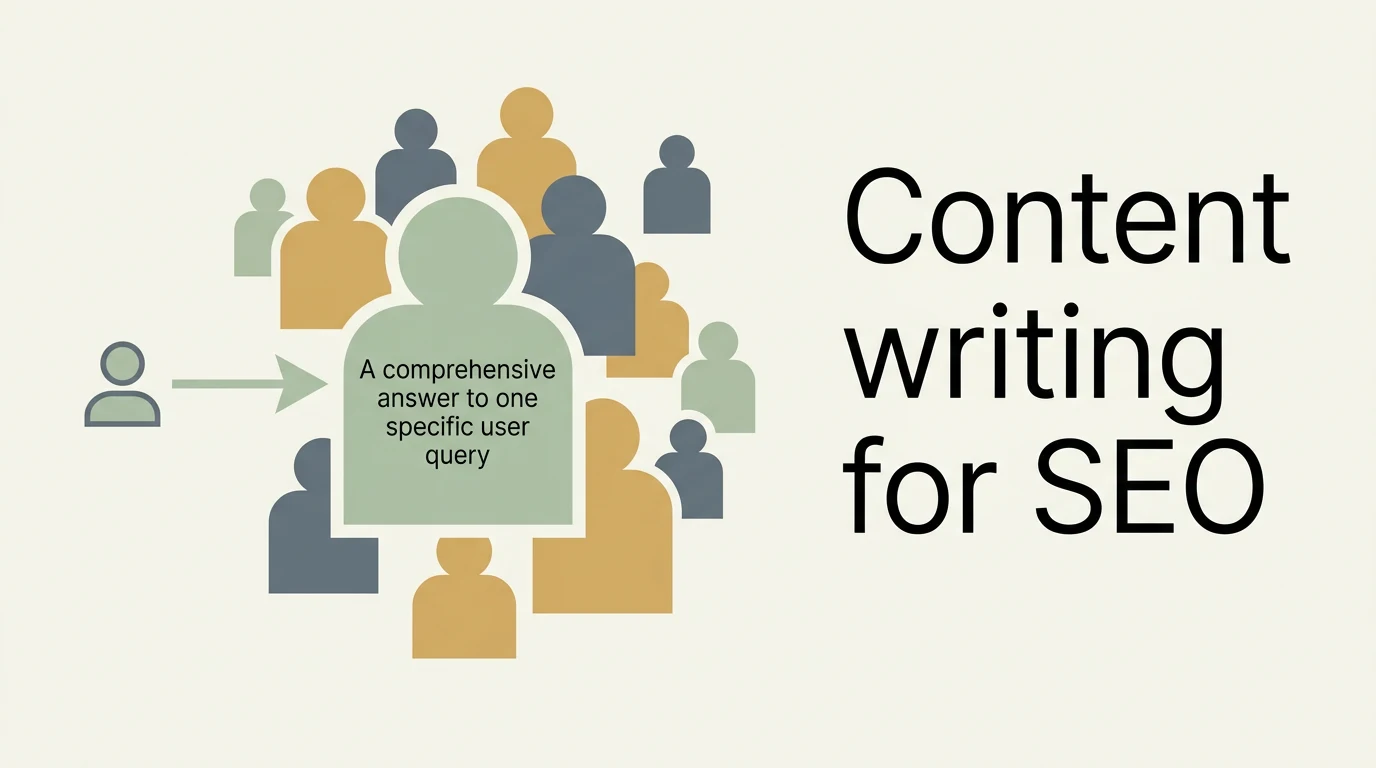
Content writing for SEO means writing a page that answers one search question better than the pages around it, then making sure a search engine can read it. The writing comes first. The SEO is the checking you do afterwards.
In short: Pick one question a real person types, answer it in the first lines, and back every figure with a source. Then check the title, description and headings. Nobody can promise a rank.
I write for blogwriter.pro, which makes a blog-writing app, so I'm on the seller's side. This post is about the craft, and you can do all of it by hand.
What a searcher wants from the page
Someone types a question into Google. They are a bit stuck and a bit impatient. They open a few results and leave the first one that makes them hunt for the answer.
That is the whole brief. Google says as much in its guidance on helpful, people-first content: content "created primarily for people, and not to manipulate search engine rankings."
The same page lists warning signs. One is whether the content is "primarily made to attract visits from search engines". Another is whether you are "using extensive automation to produce content on many topics". If you answer yes to some or all of its questions, it says to rethink how you make content.
So the order matters. A post written to please a tool reads like it. A post written to help one person, and then checked against the tool, usually passes both.

Five steps for content writing for SEO
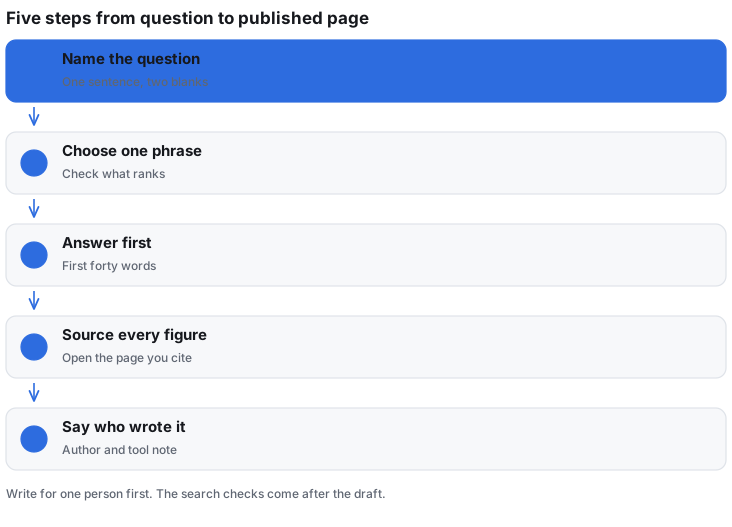
1. Name the question
Write one sentence: "Someone lands here because they want to know ___, and afterwards they can ___." If you can't fill both blanks, you aren't ready to write.
A topic is "email marketing". A question is "how often should a small shop email its list?" The question is narrower, and it is what people type.
2. Choose one phrase, and check what ranks
Pick the phrase that matches the question, then search it yourself. Read the top results. What do they answer? What do they leave out? That gap is your post.
A keyword tool helps you see which wordings people use. It can't tell you what the reader needs. Only reading the results does that. If you already have a post on the phrase, write something else, or you'll compete with yourself.
3. Answer first
Put the answer in the first forty words or so. Then tell the story, with the evidence, the steps and the caveats.
This helps a hurried reader. It also gives a search engine, or an assistant that reads aloud, a clean sentence to lift.
4. Source every figure
Most weak content fails on facts: a number with no source, a claim from memory. Open the page you're citing and read it. Write the number as the page gives it, and say who published it and when.
If a figure only appears on a company's own blog, call it their claim. If you can't trace a number, leave it out.
5. Say who wrote it and how
Google's guidance asks "who", "how" and "why". It asks whether it is self-evident who wrote the content, and whether you give background on how automation or AI was used. Put a real author on the page. If a tool helped, say so where readers would expect to find it.
Where the phrase goes, and where it doesn't
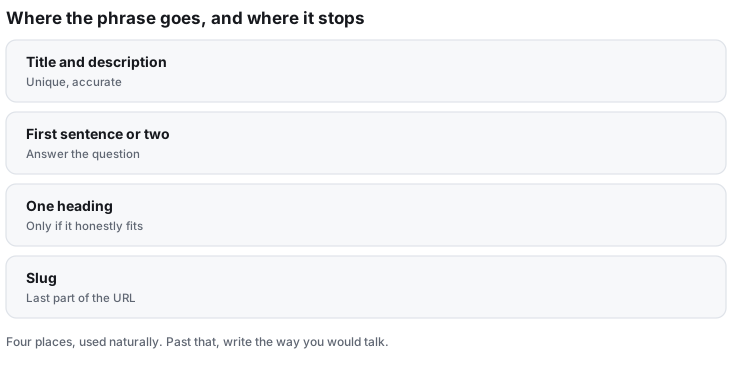
The phrase belongs in a few places, where it fits naturally:
- the title and the description
- the first sentence or two
- one heading, if it honestly fits
- the slug, which is the last part of the URL
Beyond that, write the way you'd talk. Google's SEO starter guide warns that "excessively repeating the same words over and over (even in variations) is tiring for users", and that keyword stuffing breaks its spam policies. It also says Google Search doesn't use the keywords meta tag, so skip that.
Titles and descriptions have plain rules too. A good title "is unique to the page, clear and concise, and accurately describes the contents of the page." A good description is "short, unique to one particular page, and includes the most relevant points of the page." Google doesn't always show your description, since it often builds the snippet from the page itself. Write it anyway, and write it for a person.
Things people get wrong
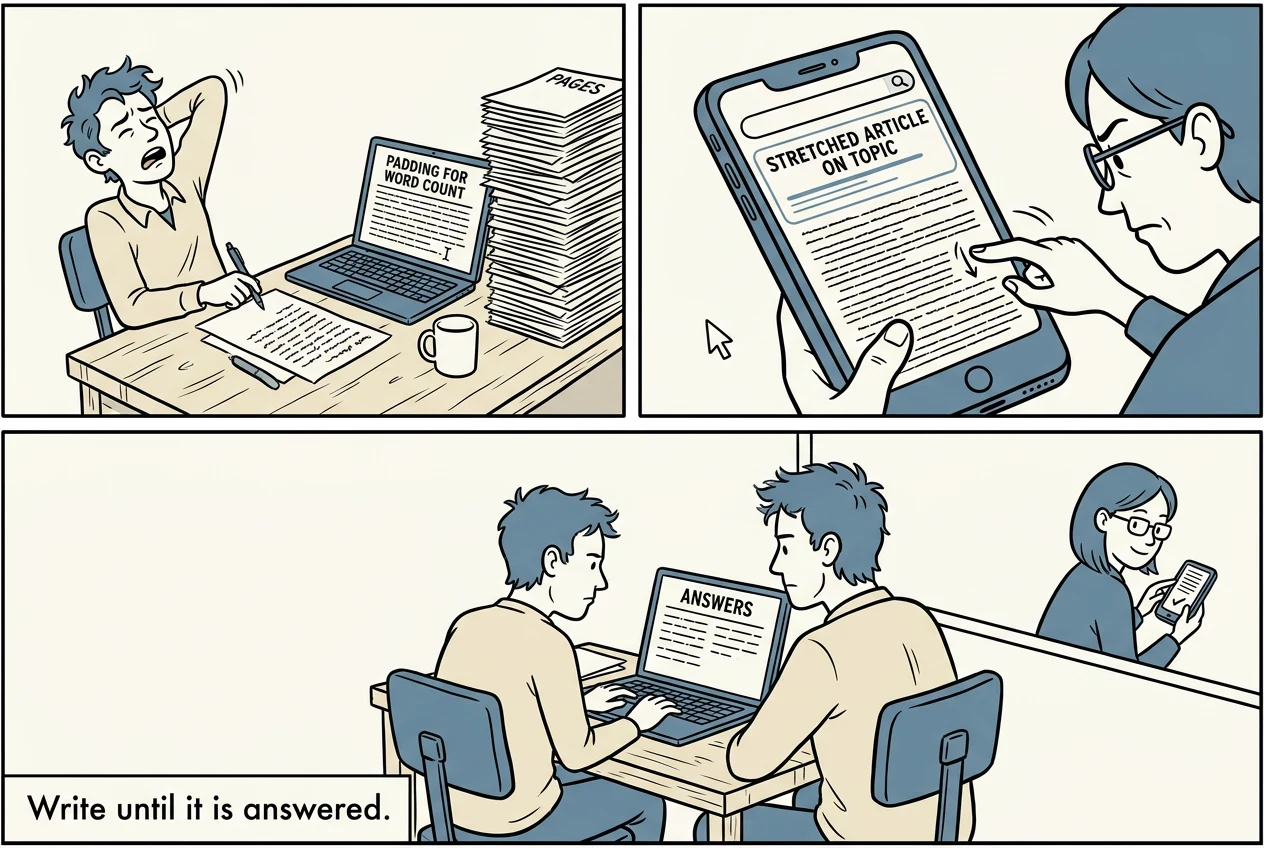
Chasing a word count. Google asks whether you're writing to a word count because you heard it has a preferred one, and answers itself: "No, we don't." Write until the question is answered, then stop.
Worrying about heading order. Its starter guide says that for Google Search it doesn't matter if you use headings out of order, and that there's no ideal number of headings. Use headings for your reader, so they can find their part.
Publishing at volume without a read-through. Google lists "using generative AI to produce large amounts of text without manual oversight or curation" as little to no effort. A person should read every post before it goes out, whoever or whatever drafted it.
Promising a result. Good content can be found, read and trusted. It can't be guaranteed a position. Be wary of anyone who says otherwise.
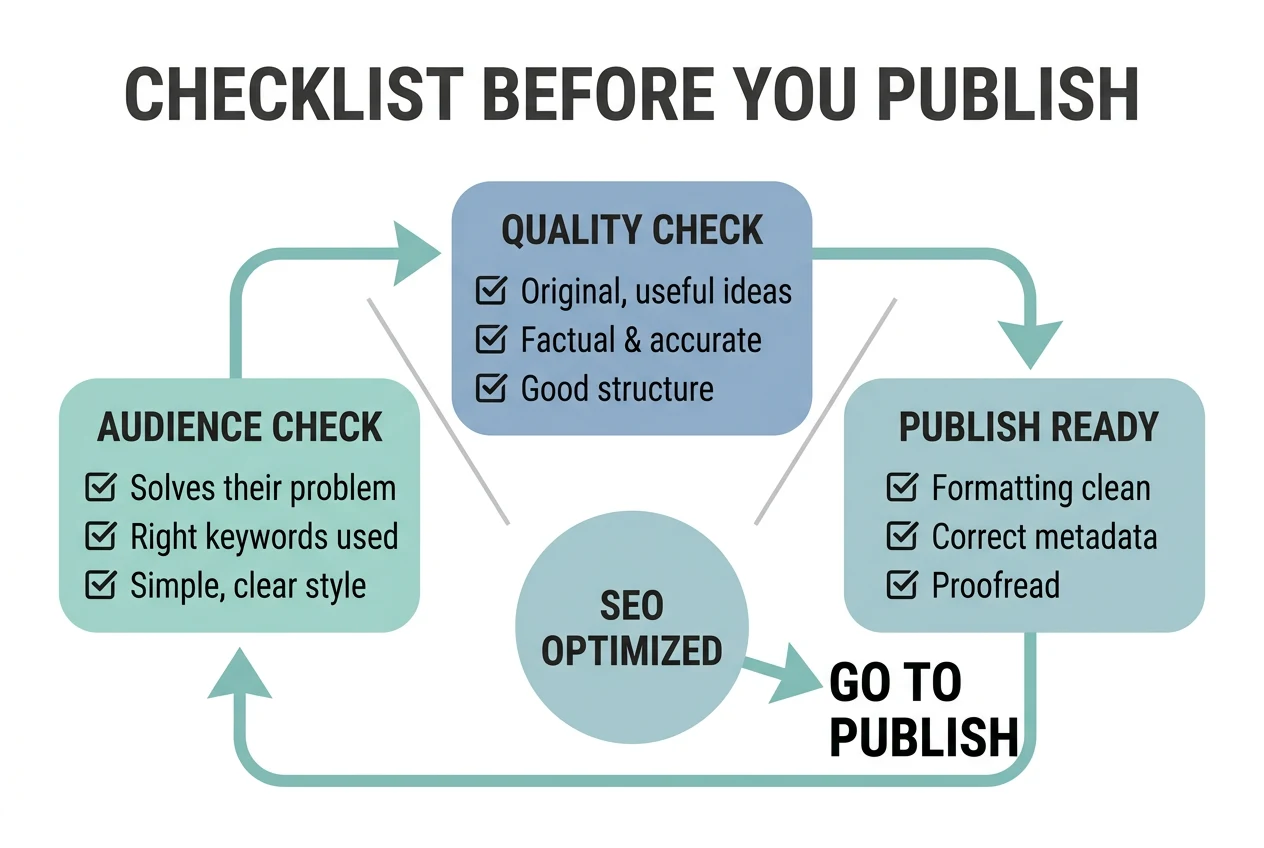
A checklist before you publish
Run this on the finished draft.
| Check | Pass looks like |
|---|---|
| The question | You can state it in one sentence |
| The opening | The answer is in the first forty words |
| Figures | Each one traced to a page you opened |
| Title and description | Unique, accurate, and written for a person |
| The phrase | In the title, opening, one heading and the slug, and nowhere forced |
| Author | A named person, and a note on any tool used |
| Links | To your related posts, and to sources for outside claims |
| A final read | Someone other than the writer has read it |
Where a tool fits
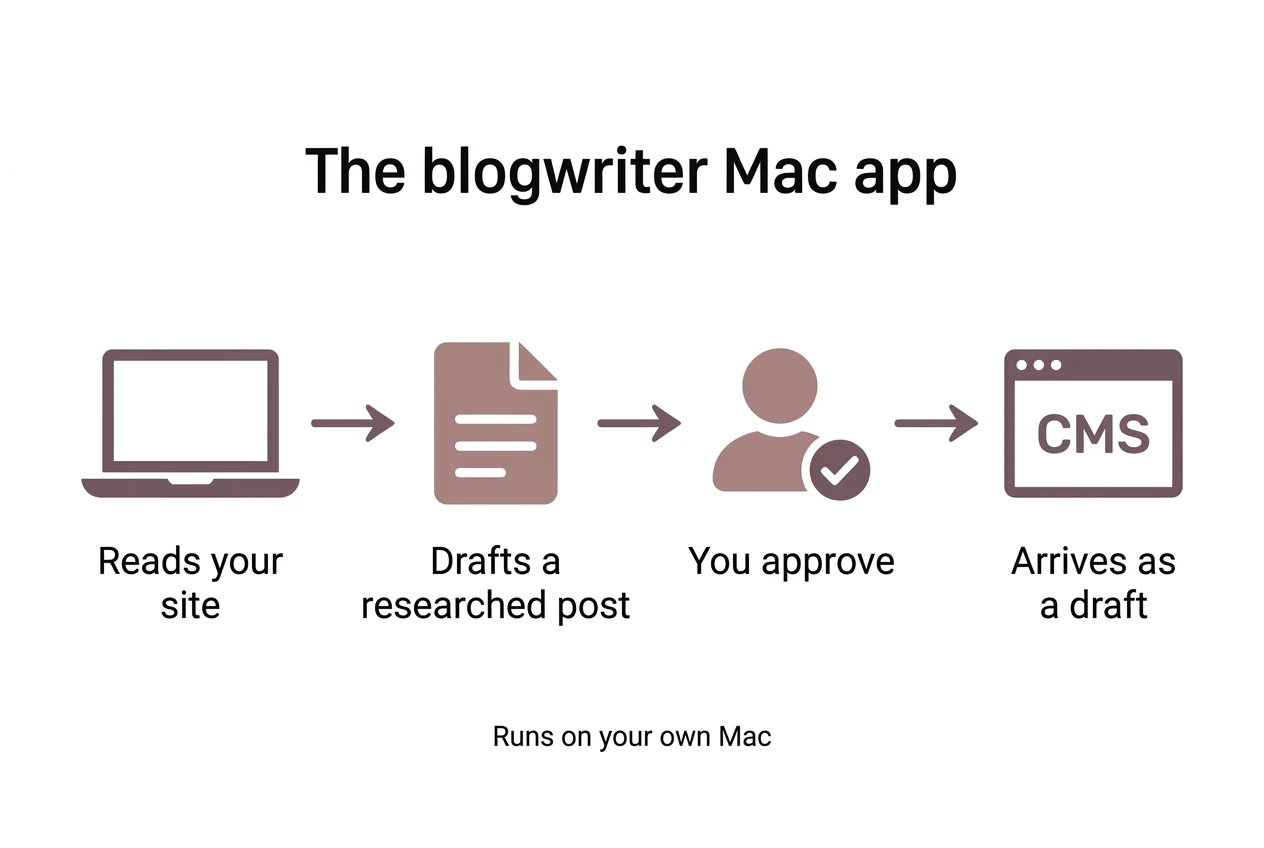
You can do every step above with a notebook and a browser. A tool only saves typing. blogwriter is a Mac app that reads your site first, then drafts a researched post for you to approve. It runs on your own Mac through your Claude subscription. Your CMS needs the Blog API or a webhook, and posts arrive as drafts. Every plan starts with five free posts and no card. Judge it by those five.
If you're planning what to put in a business blog, blog about SEO covers that side. If you'd rather hand the work over, the post on SEO blog writing services covers what to check before you pay. To practise the craft on real formats, try content writing samples. For a longer route, content writing courses covers what to check before you enrol.
FAQ
What is content writing for SEO?
It is writing a page to answer a specific search question well, then checking the title, description, headings and links so a search engine can read it. The reader comes first.
How long should an SEO post be?
As long as it takes to answer the question. Google says it has no preferred word count.
How many times should I use the keyword?
Use it where it fits, in the title, opening, one heading and the slug. Repeating it past that is tiring to read, and Google calls keyword stuffing a spam policy violation.
Can AI write SEO content?
Google's guidance asks you to be open about how automation was used, and calls large volumes of unreviewed AI text little to no effort. A person should read and approve every post.
Start with one question
Pick a single question your reader types. Answer it in the first lines, trace every figure, and have someone read it before you publish.